Palm Passage
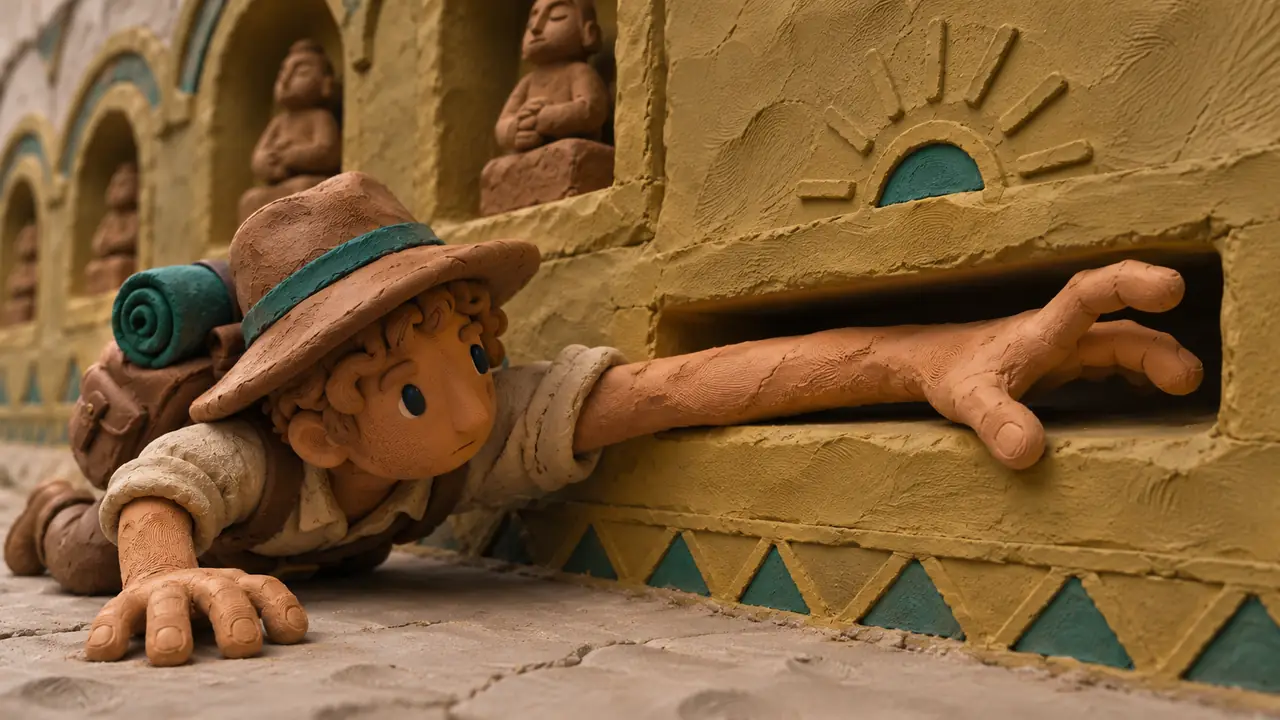
A gallery built from cardboard and thin wooden blocks contains a row of openings cut for small visitors. The clay traveler can see a clear landing beyond the first slot, but the hand in the starting pose is too wide to grab it from inside. Palm Passage gives the traveler a short place to kneel and reshape the arm before they pass through the wall.
Make a shape that fits on the first side
The basic loop is to look at an available opening, choose a part of the body to reshape, move through the set, and check what the altered shape can still do. Press one side of the hand inward and the shoulder develops a small bulge. Put the bulge behind the elbow and the upper part of the arm stays narrow enough to turn. Moving the clay as a visible mass keeps the new position understandable while you consider the next hold.
A tiny shelf inside the wall can support the hand while you turn sideways. Its upper surface stays in view from the approach, and an indented thumbprint identifies the edge you can push against. The far lip is not quite wide enough for the narrow hand to rest firmly. You can pull back to the shelf or cross the last part of the opening and use an elbow to pause on the far side.
Let the scene show where the clay went
We use warm brown bodies with quiet ochre highlights to retain small surface marks. The frame around the slot uses lighter boards so that the silhouette can be compared from both sides. A teal thread lies across the shelf just below the safe grip. The markings are part of the set and remain available when a player has started to move. A brief hold in the stop-motion sequence gives them a chance to notice where the surface changed.
The animation uses deliberate steps, especially when the character is pressed against something. At the far edge a flattened part of the palm rests on the board. A slight change in sound separates contact with a hard surface from a pose held in the air. Neither cue has to substitute for the visible shape of the hand.
Recover the grip while you have a place to rest
At the far lip, the traveler can draw some of the bulge forward and recover a broader palm. The shape does not jump back to its original silhouette in one frame. You start from the compressed pose and retain a narrow part that can remain against the shelf while material moves. If the next obstacle is another narrow gap, you can stop while the grip is useful and preserve the part that will fit.
Palm Passage is in prototype development. The current exercise tests the squeeze and the return to a broad hold. The pressure and volume study describes where the extra clay goes. The return pose note follows the movement of the bulge after the traveler crosses. In the Clay Loop the opening sits beside a different use of contact on the bridge.