Soft Span
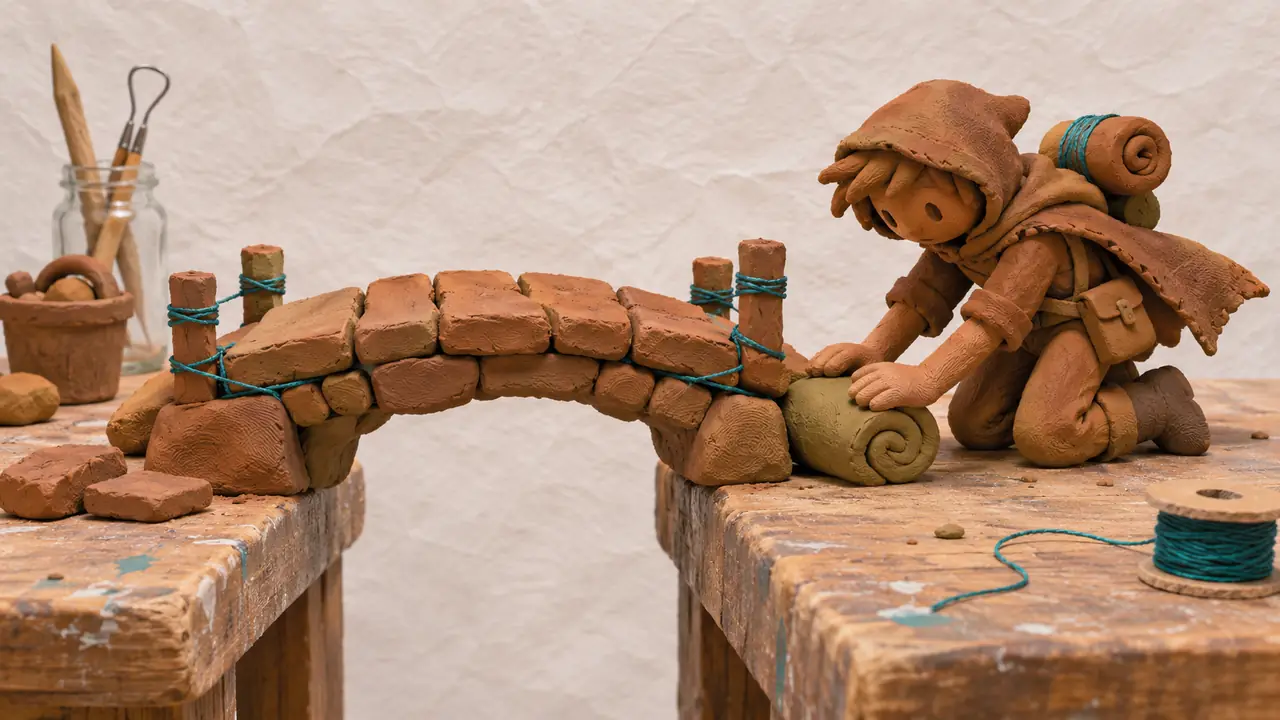
The studio set for Soft Span leaves a short gap between two worktables. The traveler can reach a small beam underneath, but an ordinary hand does not cover enough of it to produce a stable bearing. The prototype asks how to flatten clay into a support, cross with care, and still have enough material to deal with the next gap.
Shape the first support against a board
From the near table you can see a shallow pin where the set was assembled. Kneel there and lower a thick part of the arm to the beam. Press the side of that clay outward to make a contact patch. A narrow support can reach farther and may be enough to carry a hand. It leaves too little clay where the character needs to put a foot. The wider shape makes the earlier part of the crossing more stable, leaving less material to spread out later.
The main loop uses a test step to show how the surface responds. The traveler can stay beside the beam while the support bears one foot. An uneven part rises where it loses contact with the board. Move clay back toward that support or change the angle of the step before moving your weight across. The change should be visible in the material itself, so the next choice can be made while the character still has somewhere to stand.
Preserve the look of a small construction
The set uses warm wood, loose paper and shallow shadows. A dark brown support takes an ochre edge where it is pressed thin against the beam. Deeper clay keeps a little of the thumbprint that formed it. The near face should look like something an animator handled recently, with a quiet light behind the irregular edge. A teal cord marks the split between the two boards and supplies a scale reference below the support.
Frames keep a visible distinction between pressing and pulling. The first change spreads along the beam. The second pulls the support away from its edges. A slight pause marks the weight transfer near the center. When a position is held long enough to inspect, the soft clay remains a little wider at the hand than it is where it carries the foot.
Take back what you will need again
Once the character stands on the far table, they can pick up a little of the material from the nearest part of the bridge. Removing too much narrows a section needed to cross back. That gap stays in the model. A later obstacle may reward keeping the span usable rather than using everything for the next step. The player can examine the contact points again before deciding.
Soft Span is in prototype development. Our current exercise tests a single beam, supported by one patch, and a decision about recovering clay after crossing. The bearing note describes the first test step. The seam study follows what stays visible during a pose change. Return to the contact entry in the Clay Loop for another route into the same set.